Rochester's housing market is balanced, not broken. The median sold price held at $344,500 in October, up 1.3 percent from a year ago, while asking prices have fallen 22 percent from their February 2025 peak. Mortgage rates are back near 7.3 percent after a hot inflation report, and the Federal Reserve is now almost certain to raise rates in December. For Rochester buyers, that combination means the most negotiating room in years. For sellers, it means pricing to today's market, not last year's peak.
The national picture in brief
Hours before the report, Fed Governor Christopher Waller had set a public test: if monthly core inflation stayed around 0.3 percent, a larger December move should be considered. The report landed exactly on that number. The market now puts a December rate hike at about 90 percent, with a small chance it is a half point rather than a quarter point. The daily mortgage rate tracked by Mortgage News Daily jumped back to 7.3 percent after the report, even though the weekly Freddie Mac survey still showed 7.18 percent. Fannie Mae now expects the 30 year rate to average about 7.5 percent in every quarter of 2027.
The surprising part is what lower rates did not do. Rates fell three weeks in a row, and buyers still stayed away. Purchase applications were down almost 20 percent from a year ago in the last week of October, according to the Mortgage Bankers Association. Nationally, inventory is growing, up 8.8 percent from a year ago, but new listings fell 5.2 percent in the same week. The pile of homes for sale is growing because homes are sitting unsold, not because sellers are flooding in. Price cuts now show up on 20.5 percent of listings, the highest October share since 2022.
Both sides are waiting at the same time. Sellers do not want to give up a cheap mortgage. Buyers do not want a monthly payment that does not work at 7 percent plus. That is a standoff, not a crash, and standoffs can last a long time.
Rochester: two numbers that tell the story
Live MLS data for Rochester shows 900 homes for sale, a median sold price of $344,500, homes averaging 62 days on the market, and three and a half months of supply. That is a balanced market, with room for both sides to negotiate. In October, 415 homes sold, down almost 9 percent from a year ago, and 549 homes were newly listed.
The more interesting number is the asking price. New data shows the median asking price in Rochester at about $422,000 in October, down 6.3 percent from a year ago and 22 percent below its February 2025 peak of $543,000. Asking prices per square foot are down almost 5 percent, and the number of homes for sale in Rochester is up 60 percent on last year.
Sold prices are flat. Asking prices have fallen hard. The gap between them is the story of this market.
What the asking price gap really means
The homes selling in Rochester are the ones whose sellers accepted the new reality. The homes still sitting are mostly the ones priced for the February 2025 peak. A median asking price of $422,000 against a median sold price of $344,500 tells you the adjustment is concentrated at the higher end of the market, where the peak pricing was most aggressive.
This is good news disguised as a warning. It means the correction in Rochester is happening through asking prices, not through sold prices collapsing. Sellers are doing the adjusting before buyers have to force it. That is a much healthier adjustment than the one playing out in other cities in the US
The seasonal window is open right now
October is historically the lowest month of the year for asking prices in Rochester, running about 4.6 percent below the yearly average across the last nine years. August through December is typically the best time to buy a house here, when supply is high and demand is low. We are right in the middle of that window. Only 27 of every 100 listings currently has a pending sale.
Why Rochester does not follow OTHER US CITIES
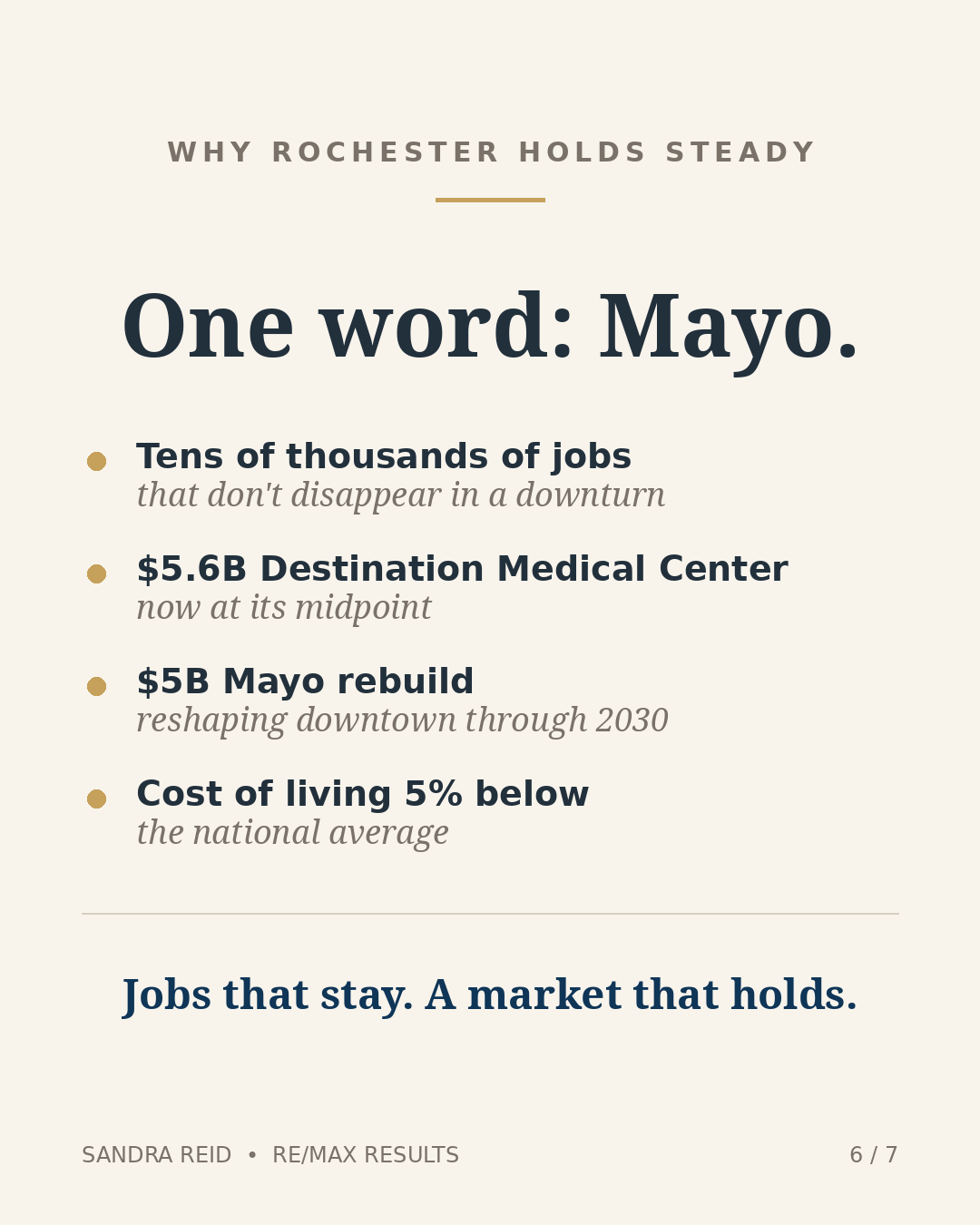
The Mayo Clinic employs tens of thousands of people here and is Minnesota's largest employer. The Destination Medical Center initiative, a 20 year, $5.6 billion public private plan launched in 2015, is now at its midpoint. Mayo's separate $5 billion Bold Forward Unbound rebuild will reshape six downtown blocks through 2030.
People move to Rochester for jobs that do not disappear in a downturn, and they stay because the employer is not going anywhere. That is a demand floor under the whole market, and it explains why Rochester's sold prices held while higher priced coastal markets corrected.
There is also a quiet affordability advantage. In a city with a world class employer, Rochester's cost of living runs about 5 percent below the national average, and the median home value sits about 5 percent below the national average too. The Pill Hill neighborhood, a historic district of homes built between 1903 and 1937 for Mayo physicians, still carries the city's clearest premium, and where you land in Rochester depends mostly on your distance from Mayo.
What this means if you are buying in Rochester

This is the most leverage Rochester buyers have had in years. Inventory here is up 60 percent from a year ago, homes are sitting for about two months, and we are in the seasonal window when asking prices are at their lowest. The rate is the problem, not the house. Get your financing lined up first so you can take advantage of this market. And remember that you are negotiating in a balanced market, not begging in a bidding war. A realistic offer, made now, has room to land.
What this means if you are selling in Rochester
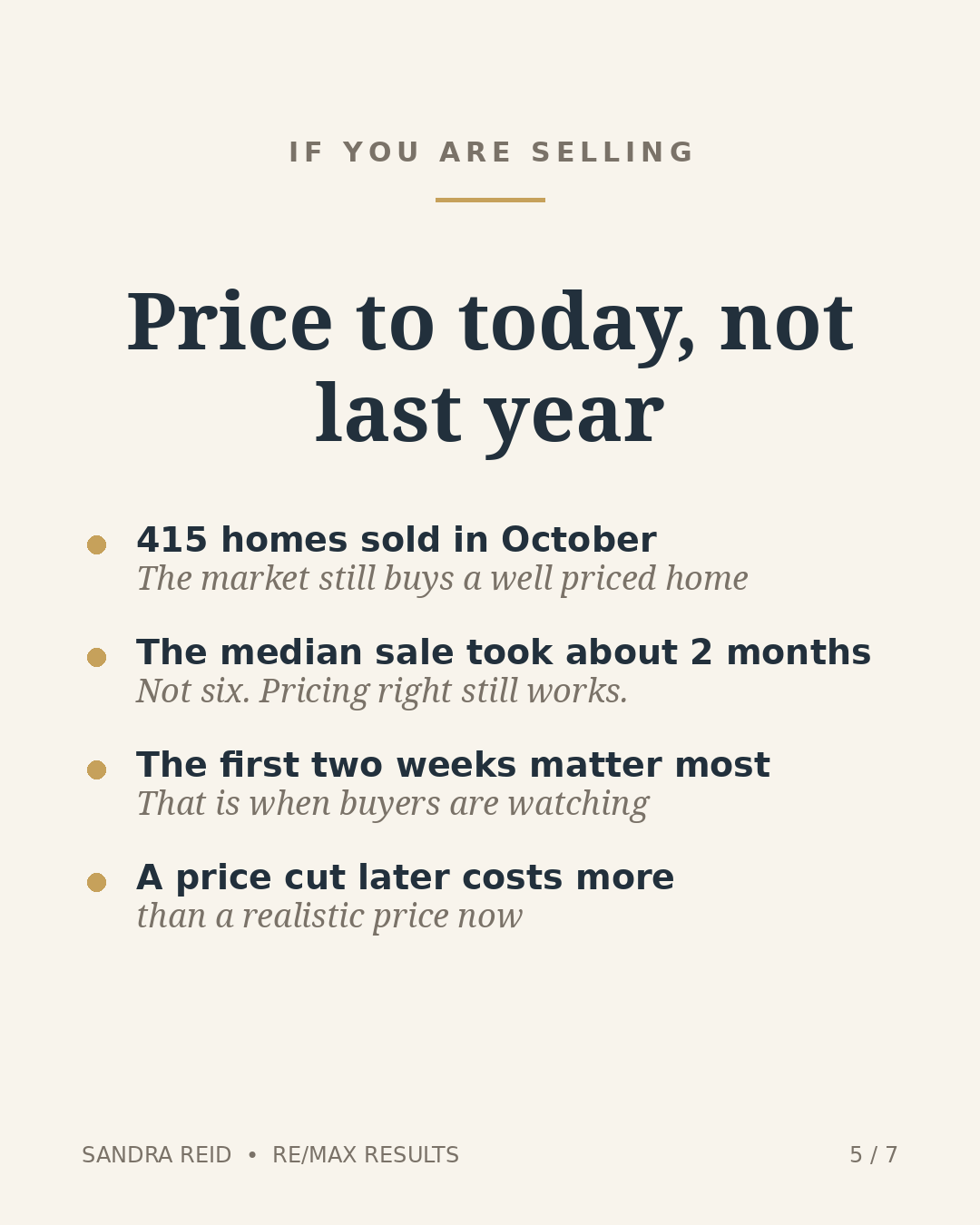
The market will still buy a well priced home. 415 homes sold in October, and the median sale took about 2 months, not 6. But the asking price data is a warning. Sellers who priced at the 2025 peak are the ones still sitting. Price to the market that exists today, not the one from February of last year. The first two weeks on the market matter more than ever, and a price cut later costs more than a realistic price now. Homes priced right in this market still sells. A home priced for last year waits.
What to watch next
The next Freddie Mac survey lands Thursday, and it will be the first one to capture the post inflation move in rates. The minutes from the Fed's October meeting come out November 18, and they will show how divided the committee was before the jobs and inflation reports. The November jobs report arrives December 4, and then the Fed meets December 8 and 9, with a hike now almost fully expected and the size of it the open question. The deeper thing to watch is whether buyers respond to lower asking prices the way they did not respond to lower rates. Cheaper money alone did not bring buyers back. If falling asking prices do what falling rates could not, that is the moment this standoff starts to break.
Frequently asked questions
Is now a good time to buy a home in Rochester, MN?
For buyers who are financially ready, the conditions are the most favorable in years. Inventory in Rochester is up 60 percent from a year ago, asking prices are at their seasonal low, and only 27 of every 100 listings has a pending sale. The tradeoff is the rate, near 7.3 percent, with Fannie Mae expecting about 7.5 percent through 2027. Buy the house you can afford at today's payment, and negotiate on price while sellers are adjusting.
Are Rochester home prices falling?
Sold prices are not falling. The median sold price in Rochester was $344,500 in October, up 1.3 percent from a year ago. Asking prices are falling, down 22 percent from the February 2025 peak. The distinction matters. Sellers are lowering asking prices, and the homes that sell are the ones priced to today's market.
What is the median home price in Rochester, MN?
The median sold price was $344,500 in October 2026, up 1.3 percent from a year ago, according to live MLS data. The median asking price was about $422,000, down 6.3 percent from a year ago. Homes averaged 62 days on the market, with three and a half months of supply.
Will mortgage rates go down in 2027?
Fannie Mae expects the 30 year rate to average about 7.5 percent in every quarter of 2027, which is not a forecast of relief. The Fed is expected to raise rates in December 2026. Rates could ease if inflation cools convincingly, but no forecast today points to a return to low rates soon. Plan around the rate you have, not the rate you hope for.
Who is the best realtor in Rochester, MN?
The best realtor for you is a local expert who knows Rochester's neighborhoods, understands relocation, and will tell you the truth about pricing even when it is not what you want to hear. Look for someone who works in Rochester every day, knows the Mayo Clinic relocation picture, and prices from live market data rather than last year's peak. That is the work I do. If you want a straight answer on what your home is worth today, or what it would take to buy the one you want, I am happy to talk it through.
About the author: Sandra Reid is a full time REALTOR with RE/MAX Results in Rochester, Minnesota, and a Mayo Clinic relocation specialist. She helps buyers and sellers across Rochester with local market data, pricing strategy, and hands on support through inspection, closing, and beyond. Reach her at 507-722-9790, sandra@yourpropertyrep.com, or www.yourpropertyrep.com.
Published November 11, 2026. Market data: Freddie Mac, Mortgage Bankers Association, Realtor.com, Redfin, CME FedWatch, Bureau of Labor Statistics, Fannie Mae, Rochester MLS and Dynamic RE. Figures are as reported in November 2026 and change weekly.
